徳島県鳴門市のオーガニックファーム
オーガニック野菜の生産・販売。
自然の恵みを活かした野菜で、健康な生活をサポート!

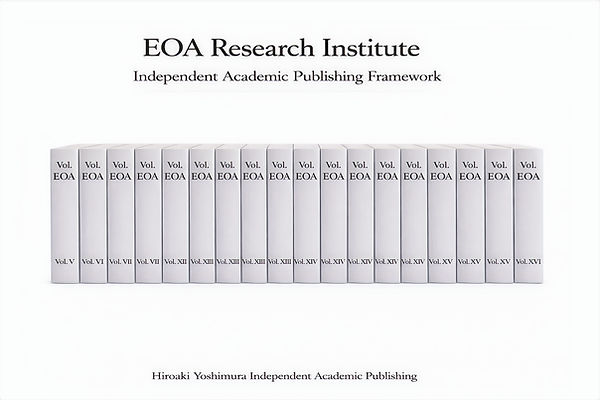
Architecture Overview
Canonical Architecture of Electronic Organic Agriculture (EOA)
The publications listed herein constitute the formally structured Canon of Electronic Organic Agriculture (EOA).
EOA is organized as a closed, boundary-governed academic architecture composed of interdependent theoretical layers. Each volume occupies a defined structural position within this architecture and is preserved under explicit canonical governance principles.
In addition to its layered organization, EOA is also structured around four principal theoretical axes: Threshold, Metabolism, Space, and Time. These axes do not replace the layer structure of the Canon, but provide the coordinate basis through which the architecture may be interpreted as an integrated theoretical system.
The Canon is arranged into:
-
Foundational Core
-
Governance & Classification Layer
-
Baseline Measurement Framework
-
Physical & State-Space Architecture
-
Non-Transition & Structural Closure
-
First Peripheral Theoretical Set — Stabilization and Governance Architecture
-
Informational Layer Architecture
-
Second Peripheral Set — Descriptive Degradation Architecture
-
Integrated Peripheral Architecture
-
Peripheral Theory Architecture v1.0 — Constitutional Declaration and Seal
-
Stabilized Second Edition Series
-
Seasonal Canon Series
-
Seasonal Coordinate Artifact
The first peripheral theoretical set establishes the primary stabilization and governance architecture of the peripheral domain. The informational layer, while structurally connected to that first set, is presented independently as a distinct architectural layer governing informational preservation, isolation, and non-operational integrity within the Canon.
The second peripheral set introduces a descriptive degradation architecture organized around Water, Time, Morph, Fatigue, and Pathogen as canonical positional layers under preserved stability, without constituting a deterministic deterioration sequence. The integrated peripheral architecture is then closed through Integrated Stability Architecture (ISA), while Peripheral Theory Architecture v1.0 constitutionally fixes, registers, orders, and seals Vols. XVIII–XXIX as the admitted peripheral architecture of the EOA Canon.
The seasonal canon series consists of bounded seasonal STB and SMB canons received under prior dependency and fixed seasonal admissibility. Spring STB 2026 is canonically fixed as a bounded seasonal STB canon within the STB domain, received under Volume X, Volume IX (Second Edition), Volume XII (Second Edition), and Volume XIV (Second Edition). It is derivative, subordinate, terminal within that dependency order, and does not function as a seasonal report, practical guide, predictive model, or generalized seasonal doctrine.
The seasonal coordinate artifact is distinct from the seasonal canon input layer. Winter 2026 is preserved as a bounded Seasonal Coordinate Artifact that receives immediate seasonal canonical inputs and ISA-integrated reception under prior dependency.
All volumes are maintained under explicit canonical preservation principles. No adaptive extensions, derivative reinterpretations, or informal expansions are recognized outside the formally declared Canon. The Canon is preserved under positional integrity, governance constraints, and non-extension principles.
Series Structure
Structural Organization of the EOA Canon
The Canon is organized into structural layers.
Each layer serves a defined theoretical function within the architecture.
I. Foundational Core
The irreversible theoretical foundation of Electronic Organic Agriculture.
-
Vol. V — ODRI Standard
-
Vol. VI — EOM Core Theory
-
Vol. VII — Boundary & Competition Framework
-
Vol. IX — Boundary-Governed Systems Engineering
-
Vol. X — Closure & Non-Extension Declaration
II. Governance & Classification Layer
Structural interpretation, system classification, and authority governance.
Ring Shift Series
-
Vol. XI — Core Structure
-
Vol. XI-1 — Canonical Types
-
Vol. XI-2 — Composite Configurations
-
Vol. XI-3 — Pathological Configurations
Decision Governance Engineering
-
Vol. XI-B1 — Measurement-Induced Boundary Collapse
-
Vol. XI-B2 — Non-Intervention Limit Engineering
-
Vol. XI-B3 — Authority Governance
III. Baseline Measurement Framework
Normative reference systems for threshold and metabolic observation.
-
Vol. XII — Standard Threshold Baseline (STB)
-
Vol. XIII — Standard Metabolic Baseline (SMB)
IV. Physical & State-Space Architecture
Formal coordinate and constraint modeling of organic systems.
-
Vol. XIV — State Space Cube Model (SSCM)
V. Non-Transition & Structural Closure
Definition of non-transitionary system states.
-
Vol. XVII — Non-Transition World Theory (NWT)
VI. First Peripheral Theoretical Set — Stabilization and Governance Architecture
Canonical first peripheral set integrating temporal, branching, metabolic, observational, and interpretive governance structures under boundary-governed stabilization.
-
Vol. XVIII — Phase Preservation Theory
-
Vol. XIX — Non-Escalatory Divergence Theory
-
Vol. XX — Metabolic Quiet Persistence Theory
-
Vol. XXI — Envelope-Constrained Continuity Theory
-
Vol. XXII — Judgment Suspension Stability Theory
VII. Informational Layer Architecture
Canonical informational layer governing informational purity, observational preservation, and structural isolation from operational control.
-
Vol. XXIII — Informational Layer Theory
VIII. Second Peripheral Set — Descriptive Degradation Architecture
Descriptive architectural layer of bounded degradation domains under preserved stability, integrating Water, Time, Morph, Fatigue, and Pathogen as canonical positional layers rather than a deterministic deterioration sequence.
-
Vol. XXIV — Localized Hydraulic Limit Theory
(Water / Spatial Seed Layer) -
Vol. XXV — Pre-Transition Observation Theory
(Time / Temporal Seed Layer) -
Vol. XXVI — Leaf-Stem Relaxation Propagation Theory
(Morph / Visible Morphological Layer) -
Vol. XXVII — Static Fatigue Accumulation Theory
(Fatigue / Non-Visible Burden Layer) -
Vol. XXVIII — Pathogen Seeding Theory
(Pathogen / Biotic Triggering and Localized Infection Seed Layer)
IX. Integrated Peripheral Architecture
Canonical integration layer closing the architectural relation between the First Peripheral Set and the Second Peripheral Set under SSCM coordinate fixation and NTW non-transition governance.
-
Vol. XXIX — Integrated Stability Architecture (ISA)
(Integrated Peripheral Architecture / Stability-Seed Closure Layer)
X. Peripheral Theory Architecture v1.0 — Constitutional Declaration and Seal
Constitutional declaration and seal-bearing volume through which Vols. XVIII–XXIX are formally fixed, registered, ordered, and closed as the admitted peripheral architecture of the EOA canon. This volume does not introduce a new peripheral theory or an additional substantive layer beyond ISA.
-
Vol. XXX — Peripheral Theory Architecture v1.0
(Constitutional Declaration, Registry, and Seal of the Peripheral Domain)
XI. Stabilized Second Edition Series
Formally re-canonicalized reference volumes.
-
Vol. IX (Second Edition)
-
Vol. XII (Second Edition)
-
Vol. XIII (Second Edition)
-
Vol. XIV (Second Edition)
XII. Seasonal Canon Series
Operational seasonal reference within canonical constraints.
These volumes document field-based seasonal validation under canonical constraints.
-
Vol. XV — Seasonal STB (Winter 2026)
-
Vol. XVI — Seasonal SMB (Winter 2026)
-
Vol. XXXII — Seasonal Standard Threshold Baseline (STB): Spring 2026
(Bounded Spring 2026 Seasonal STB Canon) -
Vol. XXXIII — Seasonal Standard Metabolic Baseline (SMB): Spring 2026
(Bounded Spring 2026 Seasonal SMB Canon)
XIII. Seasonal Coordinate Artifact
Canonically bounded seasonal coordinate volume receiving immediate seasonal canonical inputs under SSCM coordinate fixation, threshold admissibility, metabolic continuity, judgment-suspended governance, non-transition closure, and ISA integrated reception.
-
Vol. XXXI — 2026 Winter Seasonal Cube
(Bounded Winter 2026 Seasonal Coordinate Artifact) -
Vol. XXXIV — Seasonal State Space Cube Model: Spring 2026
(Bounded Spring 2026 Seasonal State Space Cube Artifact)
XIV. Seasonal Principle Theory
Canonical seasonal principle layer extracting and fixing seasonal principles from bounded seasonal STB, SMB, and Seasonal Cube sequences without converting them into cultivation guidance, prediction, optimization, or operational doctrine.
-
Vol. XXXV — Winter Principle Theory: Non-Transition Retention Principle
(Canonical Winter Principle / Non-Transition Retention Principle)
Canonical Preservation Policy
Canonical Preservation and Governance Declaration
The publications listed on this page constitute the formally declared Canon of Electronic Organic Agriculture (EOA).
The Canon is governed under explicit structural, positional, and non-extension constraints. Each volume is preserved not merely as an individual publication, but as a defined architectural component within the formally declared layered organization of the EOA Canon.
Each volume:
-
occupies a fixed and defined architectural position,
-
is preserved in its declared canonical form,
-
shall not be adaptively modified without formal re-canonicalization,
-
shall not be extended, supplemented, or reinterpreted outside the declared governance framework.
No unofficial derivatives, adaptive reinterpretations, or structural expansions are recognized as part of the EOA Canon.
Theoretical axes, interpretive correspondences, or cross-layer associations do not authorize informal restructuring of the declared Canon. Revisions, when formally declared, shall be issued exclusively as explicitly designated Second Editions or canonically registered volumes.
Authority for canonical declaration and preservation resides solely within the formally established governance structure of EOA Research Institute.
This Canon is maintained as an independent academic initiative and is publicly accessible exclusively through formally registered publications.
NEWS
Official publication updates and distribution notices for the Electronic Organic Agriculture (EOA) canon.
Distribution Update
Future EOA titles may be released through Lulu as a primary publication channel.
Availability may vary by volume and platform.
Latest release and distribution updates will be posted here.